
Comparison
Linear vs Codara: When Your Issue Tracker Talks to a Coding Agent
Linear is the best human issue tracker ever built. Once a coding agent is reading the tickets, the job changes — the tracker has to carry product context a machine can use, not just a clean UI. An honest comparison.
I want to say this part first, because the rest of the post is a critique and I would rather you trust me than feel sold to: Linear is the best issue tracker I have ever used. The speed is real. The keyboard flow is real. A team of engineers built it for engineers, and you can feel that in every shortcut. If you are weighing Linear vs Codara purely as places for humans to track work, Linear is a wonderful answer and you should probably just buy it.
This post is about a narrower question. What happens to that tracker when one of the readers stops being human? A coding agent picks up the issue now. It writes the diff. And the thing that made Linear great for people turns out to be a different thing than what an agent needs.
Linear's own team sees it. In March 2026 their CEO, Karri Saarinen, declared that “issue tracking is dead” on the same day they shipped Linear Agent. So this is not a fight about whether AI changes the job. Everyone agrees it does. It is a fight about which direction the context has to flow.
TL;DR
- Linear optimizes the issue tracker as a place humans coordinate work. That is a legitimate, hard-won win, and Linear is the best in the world at it.
- When a coding agent becomes a primary reader of the work, the job-to-be-done changes. The tracker now has to carry machine-readable product context, not just a fast, clean human UI.
- Linear is moving toward this with Linear Agent and Code Intelligence, which give the agent access to your codebase. That is real and good. It mostly flows context up from code, not down from intent.
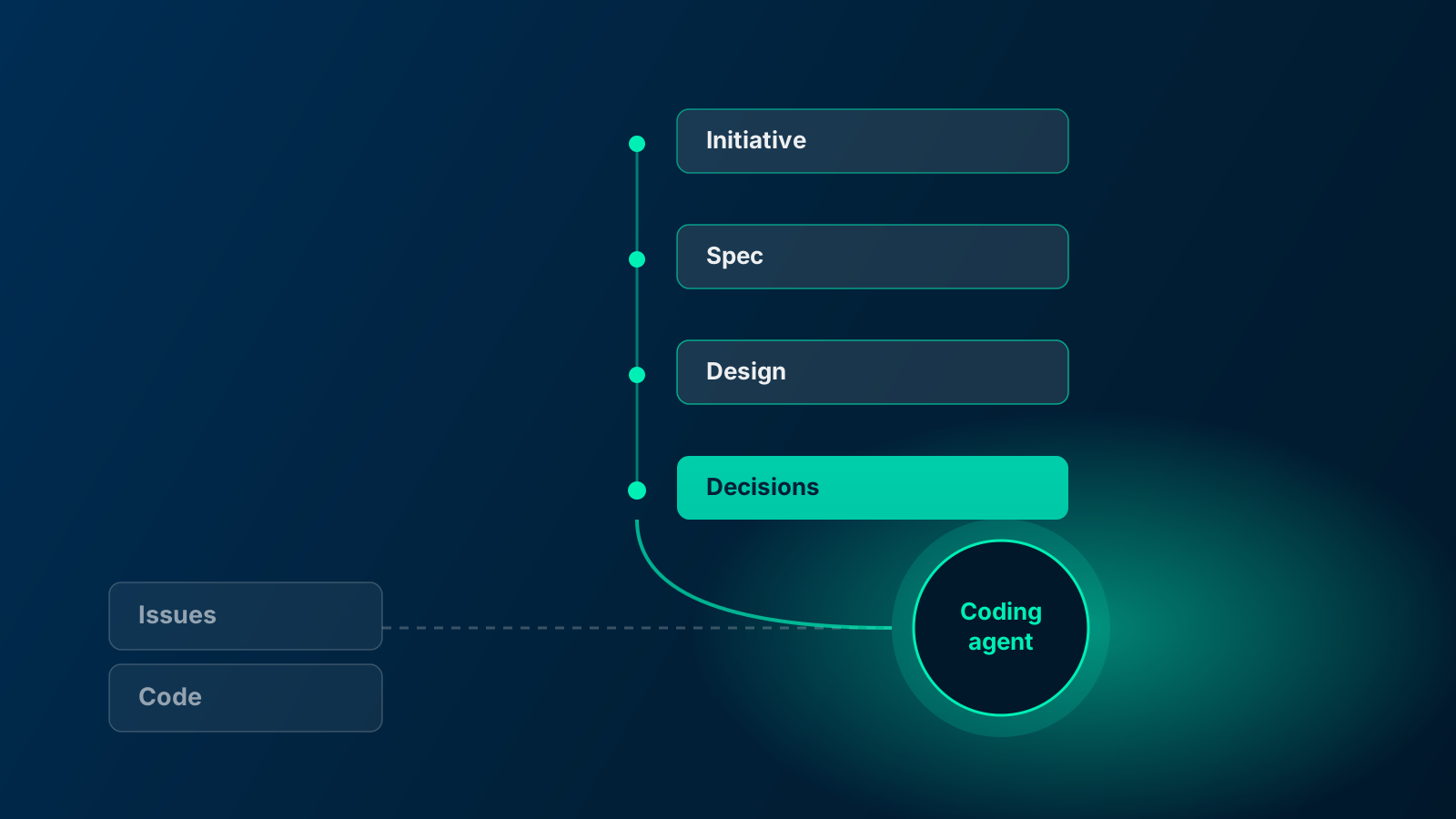
- Codara's bet is the other direction: the data model carries the upstream chain (initiative, spec, design, decisions) so the agent inherits why the work exists before it touches the code. Codara is pre-launch and unproven; Linear is shipping daily.
What was the issue tracker's job, and what is it now?
For twenty years the issue tracker had one job: be a fast surface where humans agree on what to do next and watch it move. Linear nailed that job. Status sets stay small on purpose. Nearly every action has a keystroke. The data model resists the custom-field sprawl that turns Jira into a swamp. Engineers at Vercel, Ramp, and Mercury did not adopt Linear because of a feature checklist. They adopted it because it gets out of the way.
A ticket in that world is a pointer. “Add retry logic to the payment service” works fine when a human reads it, because the human knows there is a circuit breaker on that service, remembers the incident from last quarter, and can ping the PM if they don't. The ticket was never meant to carry the answer. It points a knowledgeable person at it.
Now hand the same ticket to an agent. It carries nothing between sessions. It can't scroll back through Slack. It writes retries that compile, pass the unit tests, and fight the circuit breaker that nobody wrote down. The tracker did its old job perfectly. The job just changed underneath it, and almost nobody updated the data model to match.
What Linear is actually doing about agents
It would be cheap to pretend Linear is standing still here. They are not. Linear shipped a built-in Linear Agent in March 2026 that reads your roadmap, issues, and code, then makes recommendations and takes action. They published Agent Interaction Guidelines and an SDK so agents behave like first-class participants instead of bots spamming comments. There is even agent guidance, where you tell agents which repo to use and how to reference issues in commits.
The biggest move is Code Intelligence, which went to public beta on May 14, 2026. It gives the agent controlled read access to your repositories so it can answer how a feature is implemented or why something behaves a certain way, straight from the source. Linear describes it as turning your repositories into “shared product context.” Their own team ran over 4,000 Code Intelligence queries in April. This is a serious product, built by people who clearly understand the problem.
Read the framing closely, though. The context Linear is wiring up flows from the codeupward: the repo becomes the source of truth, and the agent reasons about how the product works today. That is genuinely useful for understanding an existing system. It answers “how is this built.” It does not answer “why are we building this, and what did we already decide.” The code can't tell you that, because the code is the output of those decisions, not the record of them.
The thing the code can't tell you
Every diff is the last link in a chain. Someone funded an initiative. A PM wrote a spec with success criteria and explicit non-goals. A designer made calls that ruled out three other flows. An architect picked an approach and rejected the obvious alternative for a reason that mattered. By the time it reaches a ticket, all of that has been compressed into a sentence, and the chain that produced it has scattered across four tools.
That chain is where intent lives. We call it the product context chain, and the argument for why it's the real gap in AI-assisted dev is its own post. The short version: an agent that sees only the code and the ticket is reading the last page of a book and guessing at the plot. It will guess plausibly. It will guess wrong in the specific ways that take a senior engineer four seconds to catch in review and four hours to unpick.
Codara's bet is to make that chain part of the data model itself. The initiative, the spec, the design rationale, and the prior decisions are connected entities the agent can traverse. When the Coding Agent picks up a story, it inherits the whole chain by default. The point is not that Codara has a smarter model. Everyone rents the same frontier models. The point is what the model is handed before it starts.
Where each tool wins, honestly
No hedging here. Each of these is a real win, and they don't cancel out.
| Dimension | Linear | Codara |
|---|---|---|
| Speed and craft | Best in class. Instant, keyboard-first, ruthlessly polished. | Unproven. We're pre-launch and have to earn this. |
| Opinionated simplicity | A single issue shape and a tiny status set. A genuine strength. | Opinionated defaults, but configurable issue types when you need them. |
| Ecosystem and maturity | Years of integrations, a large install base, daily shipping. | None of that yet. New tool, new risk. |
| Agent access to code | Code Intelligence reads your repos and reasons about the current implementation. | Comparable intent; less mature. |
| Upstream context in the data model | Specs and decisions usually live in other tools; the model doesn't hold them. | The core bet. Initiative, spec, design, and decisions are connected entities the agent inherits. |
| Built-in collaborative docs | No real wiki by design. | First-class documents next to the work they explain. |
Look at that table without a vendor's thumb on the scale and the split is clear. Linear wins on everything that comes from being a finished, beloved product. Codara's only real claim is the bottom rows: the shape of the data model when an agent is the reader. That is the whole argument. If you don't believe the reader has changed, the rest of this doesn't move you, and you should stay on Linear.
When to pick Linear, when to pick Codara
Pick Linearif you want the fastest, cleanest tracker on the market and you're happy keeping specs, designs, and decisions in Notion, Figma, and Slack. Pick it if your team is small enough that the scattered context fits in people's heads. Pick it if you want a mature tool that ships every week and you'd rather adopt agent features as a proven incumbent adds them. Those are good reasons. Most teams reading this should weigh them seriously before they get talked into anything newer.
Pick Codara if you are betting that agents will write a real share of your code, and you want the why behind the work to reach them by default. See the tight, feature-by-feature breakdown on the Codara vs Linear comparisonif you want the checklist version. And know what you're signing up for: a pre-launch tool making a bet that may be wrong, from a team that respects Linear enough to tell you so.
Common questions
Is Linear a good issue tracker for AI coding agents?
Yes, increasingly. Linear Agent and Code Intelligence give an agent real access to your issues and codebase, and the Agent Interaction SDK makes agents first-class. The open question is upstream context: Linear surfaces what the code does, while specs and decisions usually still live in other tools the agent can't read.
What does Codara do that Linear doesn't?
Codara carries the upstream product context chain in its data model: initiatives, specs, design rationale, and prior decisions are connected entities, and the Coding Agent inherits them when it works a story. It also has built-in collaborative documents and configurable issue types. Linear keeps its model deliberately minimal and pushes that context to other tools.
Should I switch from Linear to Codara today?
Probably not today. Codara is pre-launch and Linear is a mature product shipping weekly. If you love Linear and aren't leaning hard on coding agents yet, stay. Watch Codara if the agent-context gap is starting to bite your team.
Isn't this just “write better tickets”?
Better tickets help a little, but they don't close the gap. Under-specification is a property of natural language, and no amount of discipline trains it away. The fix is structural: the context an agent needs has to live in the data model, so no one has to retype it into every ticket for a reader who might not be human.
The reader changed
Linear answered the question of its era better than anyone. The question was how to make a tracker humans love, and the answer was speed, craft, and restraint. None of that is wrong now. It is just answering a question that is no longer the only one on the table.
Once an agent is reading the work, the tracker has to hold the context the work came from, in a shape a machine can use. Linear is reaching toward that from the code side, and they may get all the way there. Codara is starting from the intent side, on purpose, because we think that is the harder half and the one that decides whether the agent ships what you actually agreed to build. We're pre-launch, so treat this as a bet rather than a done deal. It's the bet we're making, and the place it starts is the product context chain.
Codara
AI agents that share one product context, end to end.
We're rolling out access to early teams. Tell us your stack when you sign up and we'll prioritise the ones we can help fastest.